Quotulatiousness

August 4, 2026

“Jason Arday’s improbable claims have turned him into a Walter Mitty for our times”

Filed under: Britain, Education — Tags: , , — Nicholas @ 04:00

The Jason Arday affair has only just drifted into my view, but it seems utterly fascinating that a young man with such a … varied and colourful personal history … has risen to be the youngest black professor at Cambridge. His backstory is (probably) too perfectly aligned with progressive worldviews to be true:

Cambridge professor Jason Arday
Image from Andrew Doyle

Jason Arday’s improbable claims have turned him into a Walter Mitty for our times. As the youngest black person ever to be appointed a professor at the University of Cambridge, there are good reasons why those who have championed him are rushing to his defence. But with each passing day, new revelations of his slippery relationship with reality seem to be emerging.

As with many fabulists, it is difficult to know where the truth ends and the fiction begins. Some of Arday’s boasts are quite obviously false. For instance, nobody believes that he completed the last nine of thirty consecutive marathons with a fractured leg that had swollen “to twice its normal size”. Or that he appeared in the television series Seven Up! as a child, even though its participants were selected in 1963 and Arday was born two decades later.

Other claims might well be embellishments on kernels of reality. No doubt he has raised money for charity, but it seems highly unlikely that his vaunted sum of £5.5 million is accurate. We know that he played snooker, but his assertion that he did so professionally would carry more weight if someone on the circuit had heard of him. Few would dispute that Arday is a keen amateur athlete. But if his claim to have run six hundred miles in six days were true, that would place him among the world’s elite sportsmen.

Perhaps most serious of all are the accusations of plagiarism. Cambridge has been quick to dismiss the matter, stating that an investigation has already been conducted by Liverpool John Moores University, where Arday completed his PhD thesis, and no evidence of plagiarism was found. Many readers who have compared the relevant passages side by side have reached a different conclusion. Numerous examples have been collated by Nathan Cofnas and can be seen here.

The refusal of the authorities at Cambridge to investigate the allegations properly has naturally raised suspicions that Arday is being protected because he is the poster boy for DEI. If it is true that he was raised on a council estate, diagnosed with autism at the age of three, first spoke at the age of eleven, and learned to read and write at eighteen, then his success story is unparalleled. Yet plagiarism is an extremely grave matter for an academic, and the evidence is difficult to dismiss.

The failure to hold Arday to the same standards as anyone else is, of course, a soft form of racism …

On Substack Notes, Michael Southron says he’s getting a strong Jussie Smollet vibe from this story:
The Jason Arday affair is beginning to remind me of Jussie Smollett.

Not because we know that Arday fabricated anything. We don’t. But because of the strange self-protecting logic that surrounds allegations of racism.

Smollett’s story was initially believed because it fitted so perfectly with what many people already believed about America: a black, gay actor attacked by racist, homophobic Trump supporters. The allegation seemed almost to validate itself.

Something similar is happening with Arday.

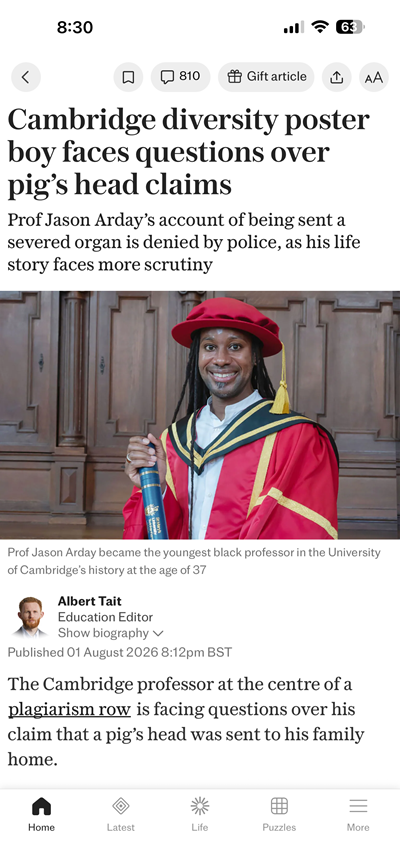
He says a severed pig’s head was sent to his family home. Yet police can reportedly find no record of the investigation he described. The butcher he said police visited says no officers ever came. There are apparently no photographs or contemporaneous messages.

He also says a masked man twice entered his Cambridge faculty building and threatened him, on one occasion with a knife. Yet the man was apparently captured by no CCTV, seen by no colleagues, and Arday reportedly warned nobody in the building at the time.

“To be honest with you, I thought you’d just believe me,” Arday told the Guardian. “Why would I lie?”

That sentence may be the most revealing part of the whole affair.

Because questioning Arday’s claims now risks being folded into the very narrative those claims are supposed to establish.

Arday says he has been targeted because of racism. Questions are raised about the evidence for his claims. Those questions are then portrayed as part of a “vile campaign” against him — which becomes further evidence that he is being targeted.

The allegation begins to protect itself.

He is a victim of racism, therefore questioning his account may itself be racist; and because questioning his account may be racist, his claim to be a victim of racism receives less scrutiny.

It is a perfect circle.
China attacked the sparrows, Britain will attack the cows

People make mistakes based on insufficient information, mistaken causes, biases, and many other distorted ways of reasoning. Governments do the same thing, but when governments screw up it’s a problem for everyone:

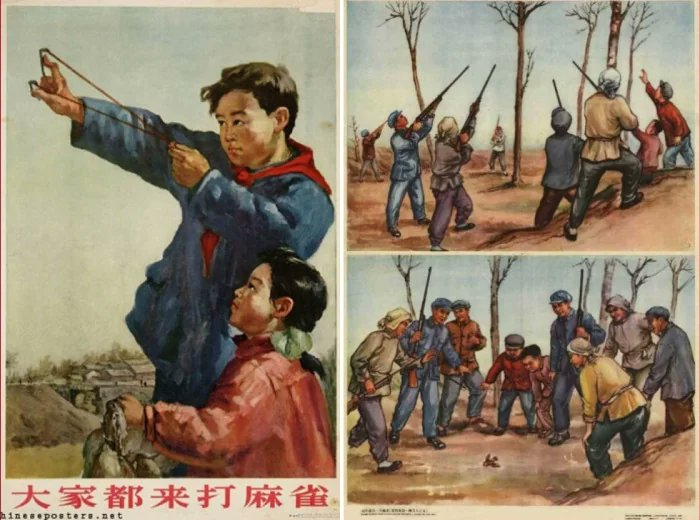
In 1958 the Chinese state worked out that sparrows were eating the grain, and organised six hundred million people to kill every one of them.

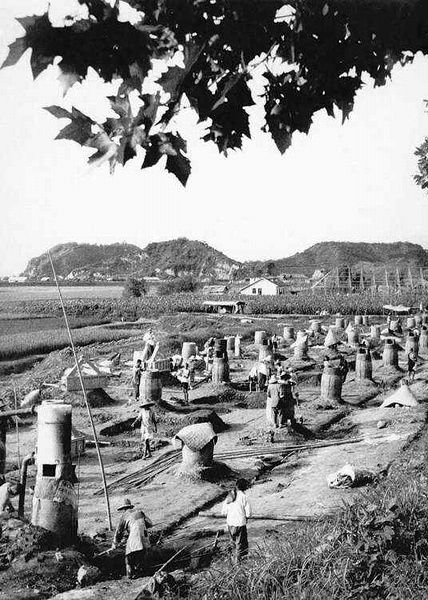
It did not take bullets. Villages, schools and factory units turned out with pots, pans, drums and gongs and made continuous noise so that no bird could land anywhere. Nests were pulled down, eggs smashed, chicks killed. The sparrows flew until their hearts gave out and dropped into the streets, where children collected them and the totals were reported upward as achievements. The toll ran into the hundreds of millions.

The arithmetic was sound as far as it went. A sparrow eats grain. Fewer sparrows, more grain, more people fed. Nobody in the room was wrong about what the bird took.

They were wrong about what it did.

Sparrows eat insects, in enormous quantity, and most of all in the breeding season when the chicks need protein. Take them out of a farmed landscape and the locusts and grain borers they had been holding down are handed the whole country. Which is what happened. Crop losses to insects rose sharply, and by 1960 the ornithologist Tso-hsin Cheng had made the case well enough that Mao ordered sparrows struck from the list and replaced with bed bugs.

Far too late, and never the whole cause. The famine of 1959 to 1961 was principally a policy famine, driven by collectivisation, grain requisition and the diversion of farm labour to backyard steel furnaces, and the dead are counted in tens of millions.

But the sparrow campaign is the purest thing in the episode, because it is the reasoning stripped to bone. A committee looked at a living system, isolated the one animal it could measure as a cost, and calculated the gain from removing it without ever asking what that animal was holding up.

Now look at what is being proposed for grassland.

The ruminant is measured the same way, on one ledger line, the methane it emits and the land it stands on. What is left off the ledger is everything it does. The grazing that keeps grassland grassland instead of scrub. The dung that feeds the beetles that feed the birds. The hoof that breaks the surface so seed can take. The mouth that removes the standing dead matter which otherwise cures into wildfire fuel. The manure that returns phosphorus and nitrogen to the soil so nobody has to mine it and ship it in.

Grasslands and grazing animals co-evolved over tens of millions of years. Remove the animal and you do not get the same field minus some methane. You get a different system, and it will not be the one on the spreadsheet.

The men who ordered the sparrows killed were not stupid, and they were not cruel. They had a number, and the number was correct, and they were praised for acting on it decisively. It took two years for the second half of the equation to arrive, and by then nobody could put the birds back.

We are eighteen months into the herd reduction schemes.

The grass has not sent its invoice yet.

Madsen Model 1945: A Rather Unusual SMG

Filed under: Europe, History, Military, Weapons — Tags: , , , , — Nicholas @ 02:00

Forgotten Weapons
Published 9 Mar 2026

At the end of World War Two, the Danish Madsen company wanted to replace its production of licensed Suomi submachine guns with a design of its own. The result was the Model 1945, a quite unusual design with a pistol-like slide. The nearest similarities would be the Polish PM-63 and the German VG1-5. The Madsen design also used an unusual hammer firing system. It was chambered for 9mm Parabellum, feeding from Suomi box magazines (not drums). Both a fixed wooden stock version (seen here) and a folding stock version were made, but only a few sales came through (apparently to Mexico and El Salvador).

Danish M1941 Madsen video: • Danish M1941 Suomi SMG

Madsen M1950 video: • Madsen M50: From the Korean War to Star Trek
(more…)

QotD: Limits to tactical flexibility in Roman Republican armies

Filed under: Europe, History, Military, Quotations — Tags: , , , , , — Nicholas @ 01:00

the real reason I wanted to run through the Roman system […] is actually to demonstrate the limits of this kind of synchronized discipline. Because yes, this sort of drill and training allowed constituent units to potentially maneuver more dynamically and flexibly (when under competent leadership; it is quite striking that Roman command skill with this sort of thing was very dependent on the skill of the general (and one assumes by proxy the skill of his subordinate officers)), but only to do those things which they had practiced.

And therein lies the rub: just as the commander doesn’t have a multitude of points where he can intervene in the battle but rather a limited set of key decision points, so too he does not have an infinite set of potential orders he (or his subordinates) might give at any given moment. Instead, the commander (or his subordinates) has a McDonald’s menu worth of options he can employ. He can order anything on the menu and expect the unit to respond accordingly but he cannot order anything not on the menu, nor can he order an altered version of a menu item (no Big Mac without cheese; Sir, this is not a Wendy’s).

Now generals could and did use drilling in the early stages of the campaign to add one or two “menu items” to their drill so as to be prepared for this or that problem. Indeed the general preparing some sort of surprise of this sort and then deploying it against an enemy is a standard topos of effective ancient generalship (although in many cases we may doubt the purported gimmick was actually used (e.g. Dionysius 20.1.6, Dio 10.5)). But that is the thing: such extra “menu items” have to be prepared in advance and often well in advance of the battle. Caesar, for instance, anticipating war elephants drills his troops in anti-war-elephant tactics before the Battle of Thapsus (46 BC, Caes. Bel. Afr. 84). Alexander’s phalanx seems to have been drilled to respond to scythed chariots as well (Arr. Anab. 3.13.5-6).

That said the bulk of the menu was likely to remain constant. After all these “menu items”, while they have simple names are often actually fairly complex to do and train when you are dealing with units of dozens or hundreds. Turning back to our example of Company, Right Wheel! we can get a sense of the complexity of training that maneuver by the way they did it. The “right guide” (the man on the extreme right) adopts a set pace (nine inch steps) while the “left guide” moves at the normal regulated speed (note this requires training your soldiers not only to step in time but to step at standard lengths) and every soldier in the middle regulates his motion by maintaining elbow contact with the man to his side. That’s a good method to get the result, but it isn’t an obvious or simple method: the fellow training the company to do this needs to already know how to do this.

Now in the modern period with mass printing, you could print drill manuals that had all of the commands and instructions on how to do them, but in the pre-modern period that kind of mass printing isn’t an option (and our military texts almost never go into this kind of granular detail) so your officers have to learn to train the behavior by observing it and participating in it themselves. Which means in turn a great deal of your “package” is set before the army is even mustered at the beginning of the campaign season because you are relying on a package of culturally embedded knowledge about how armies ought to function. And if your culture doesn’t have that tradition, inventing it from scratch is going to be hard and take time; and by “time” I mean “decades”. Effective drill for volley fire (the “countermarch”), for instance, answered a need that had existed for most of the 16th century, but the embryonic ideas for it only started emerging in the 1570s, the actionable plan on how to do it in 1594 and it was only then finally deployed in a major battle in 1600 at Nieuwpoort.

However, the time available for that kind of training is limited. Remember that drill works by repeating the same set of actions over and over again until they become almost instinctive. That takes a lot of time and repetition! That both means it is going to be difficult to find space for new “menu items” (especially with green troops that still need to learn the basics) but also that synchronized discipline itself is expensive. Our ancient sources stress how Roman levels of synchronized discipline required diligent and continuous drilling to create and maintain.

Doing that in turn would demand keeping the soldiers in question under arms for training for long periods when they were not fighting. In the Middle Republic this seems to have been accomplished through rolling recruitment: Rome was essentially always at war and always raising armies so there were always a goodly number of veterans to train and “break in” the truly green new recruits in any given draft (though again – and I owe this notion to Michael Taylor – there are some signs that the less intense conflict of the mid-second-century leads to some dulling of the Roman edge). As we transition through the Late Republic into the Early Empire, that is replaced by the slow professionalization of the Roman army, culminating in the force of long-service professionals created by Augustus. Being mobilized in peacetime, professional soldiers could be drilled extensively (assuming their cultural values are going to let them drill you; also be wary here of assuming standing forces of “military settlers” are professional in this way).

But all of that is extraordinarily expensive. Keeping those soldiers under arms, after all, means that they need to be fed, clothed and paid. Even in a system like the Middle Roman Republic where soldiers provided their own kit out of their own wealth (because Roman soldiers in the Middle Republic were recruited from the modestly well-to-do smallholding class), by drafting those men you have removed them from that economic activity. The expense of doing this would have been in most cases enormous and of course those are resources that could be deployed to any number of other uses, including simply raising a larger army of less disciplined, well trained troops. For, say, a Greek polis given the choice between having 450 men under arms all year round and excellently trained or having 5,000 hoplites under arms only in the one month where there is a battle to fight the clear answer is the latter. A lot of things need to line up before producing armies with high levels of synchronized discipline makes sense: the state needs a lot of resources, year-round security challenges and a tactical system which is effective and demands this kind of investment. So while developing synchronized discipline offered an army a degree of greater control and flexibility, it was prohibitively expensive.

Bret Devereaux, “Collections: Total Generalship: Commanding Pre-Modern Armies, Part IIIa”, A Collection of Unmitigated Pedantry, 2022-06-17.

August 3, 2026

“Find your Honest Broker, and your problems will be solved”

Filed under: Australia, Bureaucracy, Business, China, Government — Tags: , , , , — Nicholas @ 05:00

On his Substack, Ted Gioia explains how he became the “Honest Broker”:

This particular project brought me to China. I was trying to set up an operation in a remote province, far outside my comfort zone, and couldn’t seem to figure out how to maneuver among the various interests and stakeholders. My patron was one of the wealthiest men in Hong Kong, and by using his contacts, I gained access to people who normally operate behind layers of intermediaries and gatekeepers. But even these contacts led me on an endless runaround. My sources gave me conflicting advice and confusing directions. Everything felt wrong and nothing seemed quite on the level.

I knew I needed help, but had run out of options. Then I met the drunk Australian.

He wasn’t a contact on my list, and I can’t even remember his name. This was a chance encounter in a hotel bar late at night. But this hard-drinking Australian was talkative and had interesting things to say. He had spent most of his life bouncing around the capitals of Asia, and was a high-level operator in his own spheres. He bragged about his insider’s knowledge, and claimed — with some accuracy, as I came to discover — that he knew how to maneuver in China better than the clueless Westerners who were now appearing on the scene. He had traced the secret paths to power and knew all the dangerous mistakes amateurs always make.

He reeled off a list of them. “You go into a province or city and flash around some money, then expect the local officials will help you? Forget it. They’ll rob you blind, and even make you bribe them for the privilege. Same goes for the party leaders. From each according to his ability, and all that, my friend. And forget about lawyers — the legal protections here are like this” — he held up his empty glass, then flipped it over as if to emphasize the nothingness of what he was offering to the gods of Marx and Mao. “As for the bankers, you might as well call them wankers.”

The empty glass was also a sign that I needed to order another round of the local brew, and I quickly complied. My new friend fell into a meditative silence until further libations arrived. Finally, after another sip on the stomach-destroying glass of baijiu that passed for spirits at our watering hole, I asked the obvious question.

“So what do I do? Who can I trust?”

“That’s easy, mate. You need to find the Honest Broker.”

This sounded appealing enough, but I had zero idea what my new acquaintance was talking about. He might just as well have told me to go to Oz and consult with the Wizard.

“Who, exactly, is this Honest Broker?”

“There’s at least one in every city. But don’t expect their business cards to say ‘Honest Broker’ — that’s just what I call them. But that’s exactly what they are. Sometimes they don’t even have an official position. But they are the key to everything.”

He proceeded to explain how Honest Brokers play a hidden but vital role in communities without a history of legal protections and stable institutions. Their influence and power is built solely on a reputation for straight talk and trustworthy dealings. “They are true brokers, intermediaries between others. They aren’t going to participate in your deal, no matter what it is. They are go-betweens, really. But do not underestimate the power of this kind of brokerage. Whatever you need — a loan, a building permit, political influence, a place to land a private jet, whatever — they will introduce you to the right people and steer you away from the sharks.

“And they do this for a very simple reason: their prestige is enhanced by making these connections. In many cases, they don’t even want to be paid. Or let me put that differently — you repay them by becoming a trusted contact for them in future dealings. The Honest Broker may help you for free right now, but don’t be surprised if you’re asked for assistance on something completely different months or even years later. You Yanks have a hard time grasping it, and are always looking for shortcuts. But the Honest Broker plays the long-term game, mate.

“Find your Honest Broker, and your problems will be solved.”

This proved to be valuable advice, worth far more than the cost of drinks. Over the next few weeks, I changed my approach completely. I made inquiries, compared notes, and finally found my Honest Broker — who did solve my problems, just as promised. My mission accomplished, I returned back home to California and tried to forget all about it.

I put my passport out of sight. My world shrank back to manageable dimensions, and my days were spent at the two keyboards, the piano and the word processor. I was getting back into my music groove again.

A long time went by before I realized the real importance of what I had learned in China, and how it applied to the other half of my split and fractured life. I was putting energy into a new sphere now, music criticism, and trying to create a rule book for how to make it sizzle.

Yet criticism seemed such a degraded form of writing at that juncture. I had already seen the collapse in literary criticism — in fact, I had lived through it as a student at Stanford and Oxford. The whole enterprise had turned into a circus sideshow over the course of just a few years. Critics now aspired to quasi-celebrity status, and they exploited their roles as arbiters of taste to engage in the worst sort of strutting and preening. The more outlandishly they sold out their craft, opting instead for self-aggrandizement, the larger the rewards they received. This blight took root first in France but quickly spread elsewhere. And now the taint seemed to be seeping into other forms of criticism as well. Whether the subject at hand was a movie or a meal or a TV wrestling match, the critics were the real stars, and everything else subservient to their self-serving deconstruction of anything in their path.

The Ceuta invasion as a tipping point

Filed under: Africa, Europe, Government, Media, Politics — Tags: , , , , , , — Nicholas @ 04:00

On Substack, el gato malo suggests that the “refugee” invastion of Ceuta is a “bridge too far” for the EU:

peruvian strongman oscar benavides famously said “for my friends, everything; for my enemies, the law”.

once, such a thing might have provided a succinct summation of the practice of privilege in its literal sense of “private law”. there were laws for the aristocrats and others for the commoners and still others for non-citizens and slaves.

such ideas date back to time out of mind before stone was placed upon stone in giza and stood as absolute expectation and norm in most of the world until quite recently (and pertain in many parts of the world even today). the idea that “all people should be equal under the law” was a radical alteration to social order, a repudiation of the divine right of kings and aristocrats and their monopolies on property and on violence. the literal idea that land could be owned by a commoner was an astonishing upheaval of established orders. it was also the freeing move that allowed for the west to rise and flourish and prosper, unlocking its vast human potential. one might think that people would be happy about this and cherish and protect this most foundational idea that serves as cornerstone to civilizations of liberty and plenty.

lol.

you must be new here.

[…]

spain looks to be in real danger of falling as a nation. they created a mass amnesty for illegal immigrants from places that do not believe in spain but only in tribe and who do not believe in rights but only in who may dominate whom. if one seeks to be a wrecker, it’s a brilliant incentive. pardon a million and give them access to your social safety networks and welfare payments which fund a lifestyle far in excess of where they came from (and the right to vote for more) and the next wave is already packing its bags to come. spread enough jam and you can attract infinity ants.

the US was well on its way to running this playbook (and likely has ~40 million illegals to show for it) before it was stopped. the astonishing bit was how easy it was to shut this off. you just cut off the incentives. no more free stuff, no more amnesty, no more “path to stay”, and no more “catch and release until our overwhelmed court system can have a hearing years from now”. it’s really that simple.

due process becomes rounding you up and sending you home, not giving you a nice place to live for the 3 years until your case is heard.

and it ALL comes down to prosecutors, courts, and agencies. immigration law became irrelevant not because the law changed but because enforcement did. the spectacle of american judges sneaking illegals out of courthouses to avoid their apprehension by ICE was really pretty astonishing. so too were the massive levels of entitlement fraud, literal government funded flights to needed voting districts, and the astonishing refusal to arrest or hold accountable any among them because “marginalized”. europe is worse.

the NGO bond villian insidious complex has been running the table on the west for 20 years.

and they are moving into overdrive now before the populist right forces they are giving reflexive rise to can take control.

[…]

the media is, predictably, either ignoring this or pretending it’s a humanitarian crisis of families and babies. it’s not. this is damn near all men.

and they are not behaving well.

some are claiming that many of these are criminals freed by morocco and bused to the border as a deliberate act. (this same tactic was used by central and south american regimes to dump their gangs in the US.) images of robbery, rape, and of murder are cropping up.

just what a town of 80k is supposed to do with 80k invaders and how they might be fed or sheltered or controlled remains an open question.

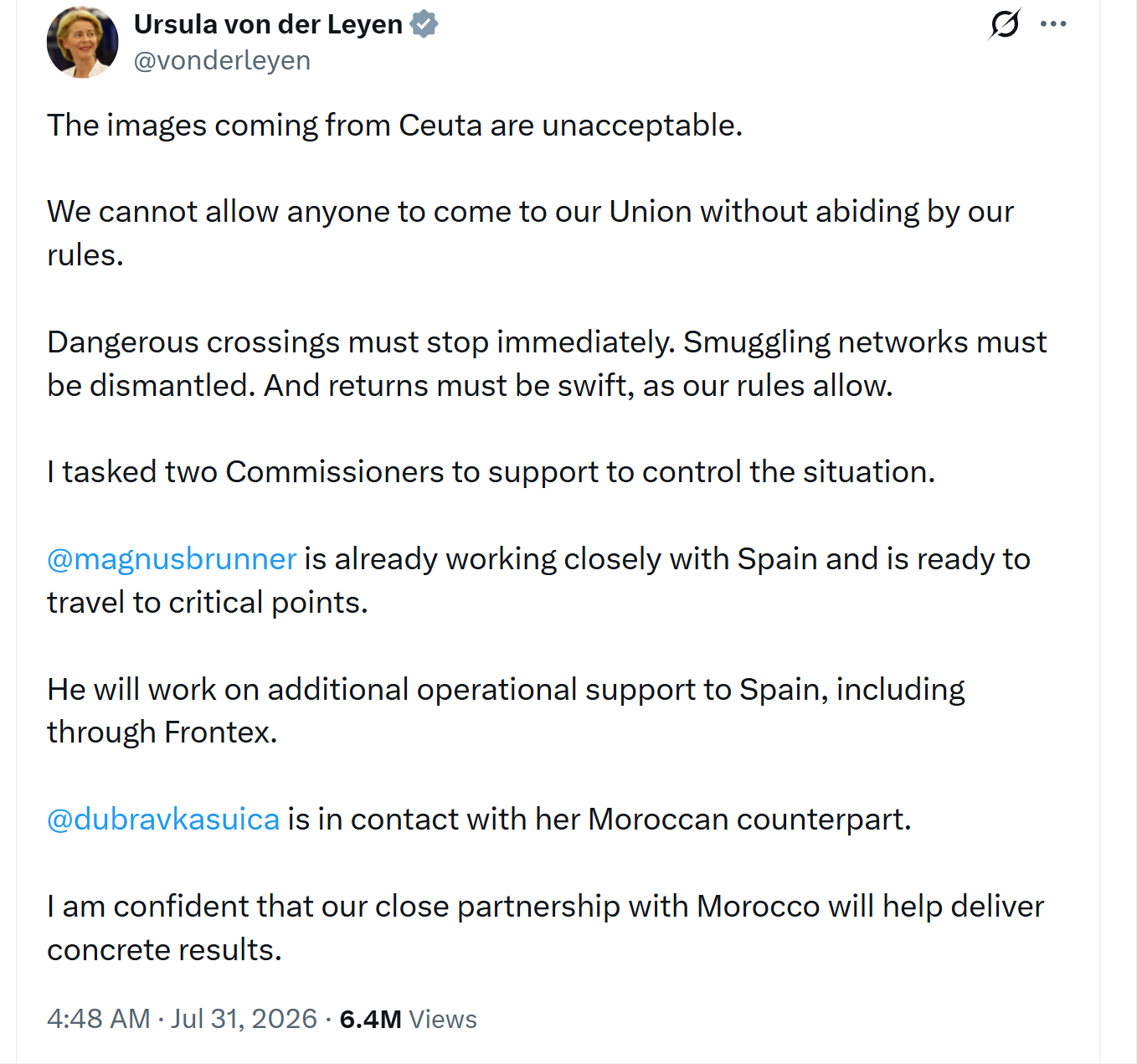
meanwhile, EU commission president ursula von doom has moved to action.

“we have sent a bureaucrat to monitor the situation. if this continues, they will tell people to ‘stop’. if that fails, they will say ‘stop’ again, perhaps in a firmer voice.”

to call this air and nonsense would be charitable. it’s an admission of helplessness. the EC relied upon a soft power it no longer possesses because it now faces people who believe only in hard power which the EC never had.

bluff called.

it’s over.

the EC was fine to govern the sort of citizens who yell at tourists for crossing an empty street against the light. it is wholly unsuited for this and like many an ill fated magician’s apprentice before them, they have now summoned that which they have no hope of controling and will eat them alive.

but here’s the part i really loved: “the images from ceuta are unacceptable”.

talk about saying the quiet part out loud. not the events. not the crisis. the images. even now, for her it’s all perception. you want to understand why they want to mandate ID to use the internet/social media and why they so desperately demand the right to censor it (once more using courts and agencies to enforce their whim)? this is why.

“for my friends, speech, for my enemies censorship and gulag”.

what they are doing cannot survive these images.

On Substack Notes, GenX Anecdotes reacts to the progressives’ response to the Ceuta situation:

I often wonder about the open borders, “migrants welcome” people and I can’t square it.

I am traditionally a left leaning person from a mixed background who has travelled extensively.

To the current progressive mind this ought to make me automatically cheering on the levels of mass migration we are living with.

But it’s the opposite.

The well travelled “anywhere” cosmopolitans should surely be the most aware of cultural differences and that it’s precisely the concept that nations are “particular” and unique from one another, that makes travelling such a fascinating and sometimes challenging thing to do.

[…]

Travelling gave me a fresh and new appreciation of little things (that actually turned out to be important things) about Britain that I had taken for granted before.

The fact that these muppets think that any form of patriotism or nationalism leads to Hitler is absolutely moronic.

And of course they celebrate it everywhere else. It’s just us who are the baddies for wanting to hold onto our traditions, customs and culture.

Why are we uniquely expected to live by different rules? Surely that in itself is kind of exceptionalist?

A progressive travelling in India wouldn’t think twice about a Mumbai taxi driver having an Indian flag hanging on his rearview mirror.

Or a Thai guesthouse having a shrine to the Thai royal family.

When you travel, people are proud of their countries and towns. They want to show you around. They tell you their country is the best proudly.

Of course, I will be here all day pointing out progressive double standards.

But this one is a biggy!

Update, 4 August: Welcome, Instapundit readers! Have a look around at some of my other posts you may find of interest. I send out a daily summary of posts here through my Substackhttps://substack.com/@nicholasrusson that you can subscribe to if you’d like to be informed of new posts in the future.

“We’ve got steel mills at home”

Filed under: China, Economics, Government — Tags: , , , , — Nicholas @ 03:00

When you want to point at amazingly vast political failures, the Chinese plan to have peasants produce steel in tiny backyard furnaces must rank near the very top of boneheaded notions. It would be funny except for the huge costs in material, environmental damage, and human lives:

Mao Zedong killed roughly 45 million people between 1958 and 1962, and the backyard steel furnace campaign sits at the center of that catastrophe as a textbook case of central planning consuming itself alive.

The logic of the Great Leap Forward went like this: if the Soviet Union industrialized through state-directed production, China would do it faster and bigger. Mao ordered peasants across every province to smelt steel in small furnaces built on collective land. Party officials set output quotas with no reference to actual resources, actual skills, or actual demand. Farmers melted down their own plows, woks, and door hinges to hit the numbers. They stripped hillsides bare for fuel. What came out of those furnaces was overwhelmingly pig iron so brittle it had zero industrial use. The quotas got reported as fulfilled, the statistics traveled up the command chain, and Beijing celebrated a triumph that existed only on paper.

You have to understand what those farmers were abandoning to stand at furnaces all day. The 1958 harvest was, by most estimates, actually decent. But with the rural labor force diverted to smelting operations, crops rotted in the fields unharvested. Free market economists call this opportunity cost: every hour a farmer spent producing worthless slag was an hour not spent producing food. The price system, had anyone been allowed to use it, would have made this tradeoff immediately visible. Prices signal scarcity. Planners just issue directives and wait for reality to disobey them.

Local officials faced execution or labor camps for reporting shortfalls, so they reported surpluses. Beijing then exported grain abroad, partly to service debts to the Soviet Union, partly to project an image of socialist success, even as provinces like Anhui and Sichuan descended into mass starvation. The state had monopolized food distribution, so when the numbers were wrong, there was no private market, no informal trade network, no alternative channel to move grain to the dying. The apparatus designed to feed people became the mechanism that starved them.

This is what the elimination of private property and price signals actually produces in practice: 45 million corpses and a generation of Chinese children who grew up stunted by famine.

Invasion of Iraq, 2003

Real Time History
Published 6 Mar 2026

In March 2003, a US-led coalition invades Iraq. US President George W. Bush claims he must disarm Iraqi dictator Saddam Hussein of weapons of mass destruction and depose a brutal regime supporting global terror. But after a lightning capture of Baghdad and other Iraqi cities in the south, the war is far from over.
(more…)

QotD: The Hellenistic Age

In the 4th century BC, the Greeks conquered the world. And that is where their problems began.

When I was a child first getting interested in ancient history, the books I read followed a smooth narrative process. The story of the Greeks began with Athenian democracy and the victories at Marathon, Salamis, and Plataea that saved Western civilization from Persian conquest. Then there was the Athenian maritime empire, and its tremendous cultural achievements: the Parthenon, Socratic philosophy, the plays of Sophocles, Euripides, and Aristophanes. There was the Peloponnesian War and Thucydides’s chronicling of it. And then, in a tremendous climax, there were the awesome conquests of Alexander the Great, who destroyed the most powerful empire on Earth and conquered the known world by the age of 33, only to die young and have his empire swiftly broken up after his death.

… And then the story would promptly lurch 700 miles to the northwest and start over. Greeks? What Greeks? Now I was reading about the rise of a different city, Rome, and the achievements of its great republic. Instead of the Assembly and the ostracism, there was the Senate and the consuls. I would read about the Samnite Wars, the Punic Wars, the Gallic Wars, and finally the great civil wars that transformed Rome from a republic into the empire that men still think about a few times a week. In this story, the Greeks appear again, but only as enemies for Rome first to easily defeat, then be culturally influenced by. This fusion of Greek and Roman culture leads to European Christianity, the Renaissance, the cultural canon — in a word, the West itself.

Kid me didn’t think too much about it at the time. But as I grew, I and many others finally had a thought intrude: Wait a minute, what the heck was going on in Alexander’s old empire before the Romans got there?

And if you’re like me, asking that question is how you wind up reading Alexander to Actium.

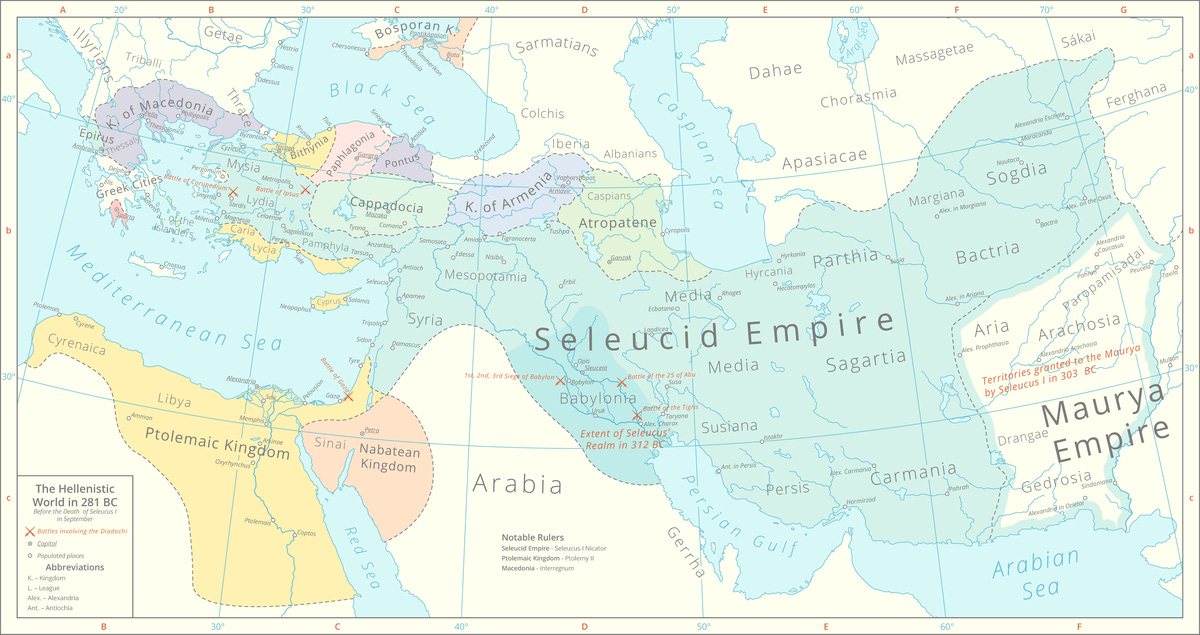
Alexander to Actium is classicist Peter Green’s gargantuan tome covering the period historians now call the Hellenistic era, the 293-year span following the death of Alexander the Great during which his vast but short-lived empire was divided up and ruled by ethnically Macedonian and Greek elites who left the stamp of Hellenic culture all across the eastern Mediterranean. The era begins with Alexander’s generals (the Diadochi, “Successors”) waging an epic forty years of war as funeral games for their dead master before finally settling into a more stable system with three great kingdoms centered on Macedon, Egypt, and Syria (plus lesser monarchies like Pergamon and Bactria). These kingdoms battled one another and Rome for another quarter-millennium, gradually losing land and power before they were extinguished, one by one. The last Hellenistic kingdom, Ptolemaic Egypt, made it until 30 B.C., when the legendary Cleopatra1 committed suicide and her realm became the personal possession of Octavian, the future Caesar Augustus. Long after their destruction, the Hellenistic legacy lingers most in religion: the Christian New Testament was written not in the Hebrew or Aramaic of Judea or the Latin of the Roman Empire, but in the koine Greek that had become the lingua franca of the educated eastern Mediterranean.

The ebb and flow of this 300-year historical epic is one that really deserves a trashy big-budget TV adaptation or three. The sordid acts of the Successors and their successors are so spectacular they could easily be made into a hybrid of HBO’s Rome and a popular show about dragons that shall remain nameless. I’m a little shocked one hasn’t been made already. To give just a small set of anecdotes from Green’s work:

  • After an attempted army revolt following Alexander’s death, the general Perdiccas holds a “purification” ceremony for the army, which consists of rebel leaders being publicly trampled to death by elephants.
  • Antigonus One-Eye, the man who came closest to reuniting Alexander’s empire, was very tall, very wide, very old, and had a very good nickname. Huge in size and huge in ambition, he dies fighting in battle at over 80 years old at Ipsus, a battle featuring 25,000 cavalry, 120 scythed chariots, and almost 600 elephants.
  • Olympias, Alexander the Great’s mother, is so vindictive that when Philip II dies, she has a rival wife and her infant daughter roasted to death on a charcoal brazier even though they pose zero dynastic threat. When her own end comes during Macedon’s multiple civil wars, the soldiers of Cassander refuse to kill Alexander’s mother – so she is instead stoned to death by the families of those she had killed during past purges.
  • Seleucus I, founder of the Syria-based Seleucid Empire, is happily married to his second wife Stratonice when he notices his son, Antiochus, is deeply enamored with her. No worry: Seleucus simply divorces Stratonice and has her marry Antiochus. This is actually a happy ending and works out for everyone, surprisingly.
  • Lysimachus, king of Thrace, is happily married to his third wife, Arsinoe, when she tricks him into having his son by a first marriage executed so her own son can succeed. This sparks a war that kills Lysimachus and destroys his kingdom, somewhat botching the whole succession thing. But no worries: Arsinoe escapes to Egypt and makes out just fine by marrying its pharaoh – her brother.
  • Cassander, king of Macedon, gets so irate at clever jabs from the wily Athenian politician Demades that he finally snaps and personally chops both Demades and his son to pieces while screaming insults at them.
  • For about a decade during the various successor wars, Athens is ruled by a literal philosopher-king, the thirty-something Macedonian puppet Demetrius of Phaleron. One of his agenda items is building a gigantic mechanical snail to crawl through the streets of Athens leaving a realistic trail of slime behind; this is apparently some artful way of shaming the Athenians for being sluggish in standing up for Greek freedom.
  • After Demetrius the Philosopher King is overthrown (by a different Demetrius, long story) the new tyrant takes advantage of divine honors granted to him to house his hoes in apartments at the back of the Parthenon. He tries to seduce a teenaged boy who instead commits suicide by jumping into a tub of boiling-hot water, and another time waives a fine against a prominent Athenian citizen in return for taking his son as a catamite. When you are legally a god, they let you do it.
  • Aratus is a quite successful Greek general with the unfortunate problem of getting uncontrollable diarrhea before every battle.
  • Escaped slave and rebel Drimakos defies authorities on Chios so successfully they simply reach a treaty with him: As long as he doesn’t steal too much and only accepts new slaves into his army who were severely abused by their masters (while sending the rest back), they’ll leave him alone. Drimakos lives to a ripe old age, then has his boy lover kill him and take his head in to claim a reward. Later, Drimakos’s spirit would supposedly appear to Chians in their dreams to warn of plots by their slaves.
  • To show off their power, the Ptolemies commission a grand procession through Alexandria whose centerpiece is “a gaudily painted gold phallus, almost two hundred feet long … and tied up, like some exotic Christmas present, with gold ribbons and bows”. Green reasonably wonders how this mighty phallus was able to negotiate corners.
  • The later Ptolemies could win some kind of ghastly award for their spectacular decadence. Ptolemy VIII Physcon (“the Obese”), who resembles a 2nd century BC Baron Harkonnen, seizes power after the death of his brother (also named Ptolemy) by marrying Cleopatra, who is also their sister. He then has her son, his nephew (also named Ptolemy), murdered during the wedding feast, then proceeds to seduce and marry his pubescent niece (also named Cleopatra). A decade later, riots forced Physcon and his niece-wife into exile, and his sister-wife proclaims her son by Physcon (another Ptolemy) as pharaoh, but the heir is apparently in Cyrene at the time, allowing Physcon to capture his unsuspecting son and send his dismembered corpse to the sister-wife as a birthday present. Meanwhile, the sister-wife’s daughter by her first brother (named Cleopatra, of course) gets married off to a Seleucid king and uses her sons as a series of puppets. The first puppet, Seleucus V, proves troublesome, so his mother murders him by using him for archery practice. The second puppet, Antiochus VIII, is more canny, and when his mother tries to murder him with a cup of poisoned wine, he notices something is up and forces her to drink the fatal cup herself. Antiochus VIII then fights a long civil war against his half-brother and cousin Antiochus IX, who is not a puppet but instead has the private hobby of playing with literal giant puppets. Got all that?

If learning the above is your idea of fun, then Alexander to Actium is a rich feast, enlivened throughout with Green’s flare for delicious details and legends that are possibly fanciful but too remarkable to leave out.

Blake Neff, “GUEST REVIEW: Alexander to Actium, by Peter Green”, Mr. and Mrs. Psmith’s Bookshelf, 2025-10-20.


  1. The Seventh, it turns out.

August 2, 2026

The hubristic disaster of good intentions in Llantwit Major

Filed under: Britain, Politics — Tags: , , , , , — Nicholas @ 05:00

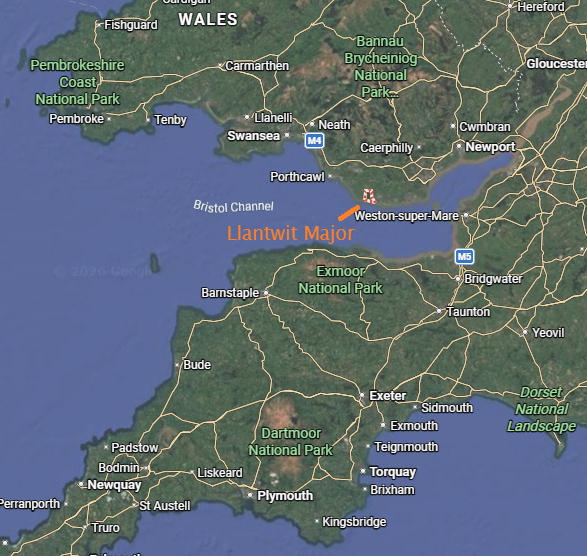
On Substack, Mark Collett recounts the sad tale of good intentions leading to very unwelcome results in a little Welsh town that was determined to welcome in foreign refugees:

“Those whom the gods would destroy, they first make mad.”

This phrase does not have a single, definitive creator but it is instead a modern English phrasing of an ancient Greek concept that evolved over thousands of years. The core meaning of the phrase comes from the classical Greek concept of Atë, which is an infatuation or moral blindness sent by the gods to punish human hubris. The earliest recorded variation appears in Sophocles’ tragedy Antigone (c. 441 BC), where a chorus remarks that evil eventually seems good to a man whose mind a god is leading to ruin. Sophocles noted even then that it was an old and famous maxim – possibly existing for hundreds of years before he used the term. However, the phrase finally took its exact, modern-day form in 19th-century American literature with the Reverend William Anderson Scott publishing the phrase exactly as it is written today in his book Daniel, a Model for Young Men, which was published in 1854, he called it a “heathen proverb”.

[…]

There is probably no better modern application for this “heathen proverb” than as a means to describe white liberals. These champions of social justice are so desperate to endorse a progressive ideology and to embrace people from other racial and cultural groups, that it often leads to their downfall. So convinced are white liberals not only of the nobility of their cause, but they are also totally sure that when their beliefs and theories are applied in the real world that they will result in the establishment of a rainbow utopia in which all people will live in blissful harmony. This is why the truth to these people is like garlic to a vampire. As such, no amount of facts, figures or even real-world examples of the potential pitfalls that could result from enacting the policies they support can dissuade the white liberal from their political path. And often, the hubris of white liberals can lead to their downfall, and sometimes, this affects more than a lone individual, sometimes, this hubris leads to the downfall of an entire community.

Photo from Mark Collett

And on the South Coast of Wales, in a small seaside town named Llantwit Major, it could be said that the residents became the living embodiment of this “heathen proverb”, that they went “mad” – however this madness was definitely not the work of the gods. The madness that had taken over the minds of the people of Llantwit Major was a form of suicidal hubris that sprang forth from their misplaced beliefs in tolerance, diversity and multiculturalism. And it was their faith in these beliefs that caused them to embrace their own demise in a desperate attempt to prove how progressive and open minded they were. This is the story of a small Welsh town of less than 10,000 people who willingly and enthusiastically welcomed a swamping number of migrants into their community and how their overwhelming arrogance resulted in a migrant camp being built in the very centre of their tiny, and previously homogenous, Welsh community.

But this wasn’t just a case of blind virtue signalling – it was possibly the most glaring example of liberal hubris on a group level that has been witnessed in recent years. The residents of Llantwit were warned of their impending fate, but not only did they ignore these warnings, but they besmirched and attacked those who they should have heeded. When it was announced that migrants would be headed to Llantwit, many nationalists were eager to help the town’s residents, and plans were made to arrange a demonstration in the area in order to assist the locals in pushing back against the proposals. But the hubris of the townsfolk caused them to reject this generous offer of help, and instead, those who wished to warn local residents of the dangers posed by such a scheme were met with resistance. This local resistance was so strong that the BBC ran a glowing article praising the people of Llantwit titled: “Patriotic Alternative: The town fighting the far-right with Welsh cakes”.

How to Make Aggression Sound Like Defense – Death of Democracy 26 – Q2 1939

Filed under: Germany, History, Military, WW2 — Tags: , , , , , , , — Nicholas @ 04:00

World War Two
Published 1 Aug 2026

By the spring of 1939, Hitler’s Germany is no longer merely threatening war, it is preparing to launch one while insisting that every act of aggression is really self-defense.

In this episode of “Death of Democracy”, we look at Germany in the second quarter of 1939: the launch of the battleship Tirpitz, the secret planning for Fall Weiss — the invasion of Poland — Hitler’s 50th-birthday military spectacle, the renunciation of the German-Polish Non-Aggression Pact and the Anglo-German Naval Agreement, the Pact of Steel with Mussolini’s Italy, and the diplomatic moves designed to isolate Poland before the coming attack.

But behind the military display, Nazi Germany’s economy is still on a knife’s edge. Rearmament, shortages, debt, plunder, and autarky have pushed the regime toward a brutal logic: conquest is no longer just ideology; it has become the regime’s chosen answer to the crisis it created.

Meanwhile, persecution inside the Reich continues to escalate. Jewish tenants are stripped of protection, the refugee ship St. Louis leaves Hamburg in a desperate search for sanctuary, and Ravensbrück opens as a concentration camp for women. As Germany exports terror into annexed Austria and Bohemia-Moravia, Britain and France finally begin to wake from appeasement — but dangerously late.

This is how aggression is made to sound like defense.

Never Forget.

“Cash for Clunkers” – the seen and the unseen

Filed under: Economics, Environment, Government, USA — Tags: , , , , , — Nicholas @ 03:00

French economist Frédéric Bastiat explained why the “Cash for Clunkers” program would fail … and he wrote about it more than a hundred years before it happened – “That Which is Seen, and That Which is Not Seen”. The US government publicized the “seen” … removing older cars from the roads in pursuit of lowering pollution. Nobody publicized the “unseen”, as Handre explains:

The Cash for Clunkers program, which Congress passed in June 2009 and burned through its $3 billion budget in under two months, destroyed functional wealth on a national scale, and somehow they called it “stimulus”.

The mechanics were simple: trade in a working car, receive up to $4,500 toward a new one, and watch government employees pour sodium silicate into the old engine to make it seize permanently. Around 700,000 vehicles got crushed. These were not rusted-out death traps. The eligibility rules required the trade-in to be drivable and insured. You were watching the state systematically annihilate usable capital because Keynesian demand theory told it that destruction generates recovery. Frederic Bastiat explained why this is wrong in 1850, in an essay short enough to read on your lunch break. Congress ignored it.

The ripple effect hit people the government never mentioned in its press releases. Mechanics lost repair work. Used-car dealers watched their inventory evaporate. Low-income buyers who depend on the sub-$5,000 market faced prices that jumped roughly 10% in the years after the program. Free market economists call this “seen versus unseen”. Politicians only showed you the gleaming new Chevy Malibu driving off the lot. They never showed you the single mother in Akron who needed a $3,000 Corolla and found nothing affordable left on the lot.

Even the environmental justification collapsed under basic scrutiny. A 2009 study by Resources for the Future calculated that the program cost between $237 and $365 per ton of carbon dioxide reduced. The voluntary carbon credit market at the time priced a ton around $10 to $20. The government spent up to thirty times the market rate to achieve an environmental outcome the market was already pricing far more efficiently.

This is what central planning always does. It takes your money, destroys real assets, and transfers wealth from the poor to auto manufacturers and their financiers. The program’s designers received awards. The Akron mother paid higher prices. The engines sat crushed in junkyards. Nobody in Washington answered for any of it.

The Ancient Greeks 03 – Enter the Persians 6 – Eretria Falls, Athens Stands Alone

Filed under: Greece, History, Middle East — Tags: , , , , , — Nicholas @ 02:00

seangabb
Published 16 Feb 2026

Greece: A Brief History, c.700 BC – 500 AD

In 490 BC the Persian fleet advances island by island across the Aegean. Eretria is besieged, betrayed, and deported. We examine Persian punitive strategy, internal Greek division, and the calculated destruction of Eretria as an example to others.

Athens now faces invasion. Pheidippides runs to Sparta. The Spartans refuse immediate aid due to religious obligation. Only Plataea stands with Athens.

This is the moment before Marathon.

QotD: Churchill’s views on India

Filed under: Britain, History, India, Politics, Quotations, WW2 — Tags: , , , , — Nicholas @ 01:00

Much of Mukerjee’s case against Churchill rests not on his actions but on his various racist comments about Indians, and Bengalis in particular. Most of these have been taken out of context. Churchill was certainly no friend to Indian nationalist leaders, most of whom he regarded as moralising humbugs. He was an unashamed imperialist, like many of his generation, and committed to maintaining India’s unity within the British Empire. He had a strongly-held conviction that too sudden and rapid a move to democracy and independence would tear the subcontinent apart on sectarian lines, a fear that events would justify.

On the other hand, Churchill repeatedly voiced his admiration for the gallantry of Indian troops, noting in his war memoirs: “The unsurpassed bravery of Indian soldiers and officers, both Moslem and Hindu, shine for ever in the annals of war. Upwards of two and a half million Indians volunteered to serve in the forces … The response of the Indian peoples, no less than the conduct of their soldiers, makes a glorious final page in the story of our Indian Empire.”

Despite his fears about Indian independence, Churchill’s views noticeably mellowed over the years. On 5 February 1942, Churchill proposed in cabinet to visit India to make its Congress leaders an offer of postwar independence, in return for their supporting the war effort. But instead the war cabinet sent its senior Labour minister, Sir Stafford Cripps, known for his friendship with Congress leaders. When the Cripps mission failed to meet their demand for immediate independence, Congress launched the Quit India movement of civil disobedience against the Raj and resolved to offer only passive resistance to the Japanese invasion.

On being informed of this in September 1942, an apoplectic Churchill exclaimed to Amery: “I hate Indians. They are a beastly people with a beastly religion.” He was referring to Hinduism, rather than Islam, given loyal support for the war effort from the Muslim League. Churchill saw Gandhi’s decision to launch the Quit India movement in the middle of the war as a stab in the back when Britain most needed and deserved loyal support.

He also (like many Indian liberals and socialists) saw Gandhi’s political fasts as a form of emotional blackmail. And he was appalled, as were many Congressmen, by extreme nationalists such as the Bengali leader Subhas Chandra Bose joining hands with Hitler and the Japanese, a fact not calculated to endear Bengalis in general to Churchill.

Churchill’s abusive comments about Gandhi, Indians and Bengalis need to be seen in that context. They also need to be seen in the context of his penchant for making outrageous comments that he didn’t really mean in order to shock or tease.

Zareer Masani, “Churchill and the genocide myth”, The Critic, 2020-12-06.

August 1, 2026

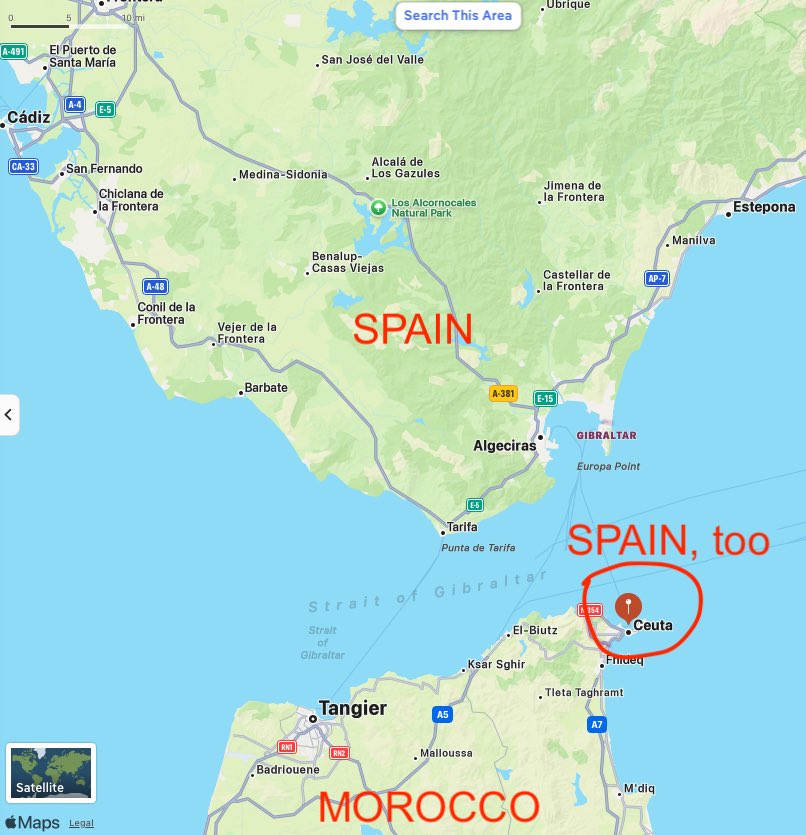
The invasion of Ceuta

Filed under: Africa, Europe, Government — Tags: , , , , , — Nicholas @ 06:00

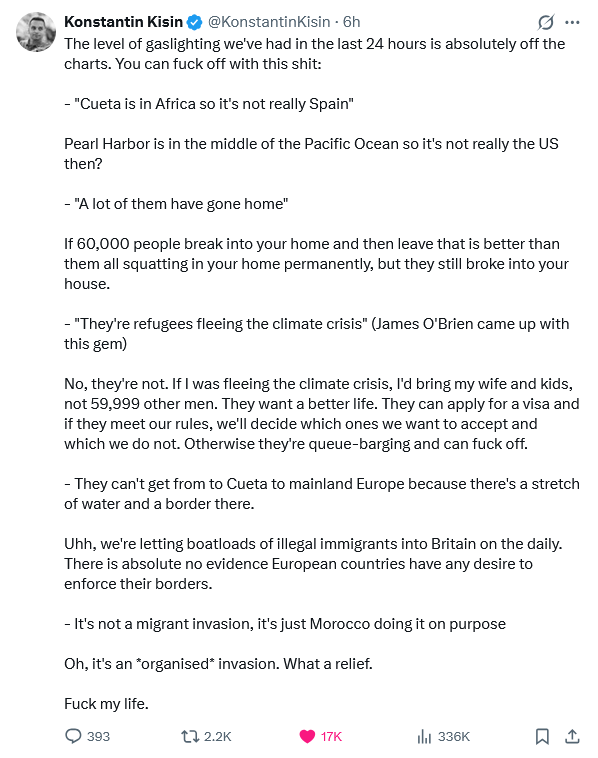
In the last 48 hours vast numbers of people have learned that Spain still has territory on the African continent, as Morocco enables thousands of young men to cross into the Spanish city of Ceuta. The Spanish government has, to time of writing, refused to declare a state of emergency or to send military forces to assist the municipal authorities in Ceuta. In Spiked, Brendan O’Neill thinks this heralds the end of globalism:

Can we say “invasion” now? What other word is there for the rough intrusion of tens of thousands of young men into the sovereign territory of a foreign nation? Surely not even the sappiest leftist in his tattered keffiyeh and “Refugees Welcome” t-shirt would describe the thuggish gatecrashing of an independent nation as “asylum seeking”? That might be the one and only upside to the extraordinary events in Ceuta yesterday: the death, at last, of euphemism. The impossibility of any longer dressing up the West’s suicidal abandonment of its borders as “kindness”.

The scenes from the Spanish enclave at the tip of North Africa are staggering. An estimated 49,000 people, mostly Moroccans, mostly men, gleefully intruded upon the territory of the Spanish kingdom. That’s around the same number of people who illegally sail to Britain in a year. They scaled border gates and overwhelmed those charged with protecting Spanish lands. Viral clips show men punching the air as they swarm the enclave, clearly thrilled with their incursion into a sovereign state. Even the Spanish press is feeling the death of euphemism. “Ceuta, invaded”, says the front page of ABC, a newspaper of record, alongside an image of thousands of men streaming along Ceuta’s beach.

The mass storming of Ceuta has focused the minds even of Spain’s fatally apathetic ruling class. All of Ceuta’s parties, both right and left, have called on Madrid to send in the army to reinforce the border with Morocco. Spanish PM Pedro Sánchez promised an “immediate response“. Yet even if the Spanish manage to tame this searing crisis of sovereign rule – and that’s a big “if” – the lessons of it should reverberate not only across Spain but all of Europe. For the fall of Ceuta exposes the lethal strain in globalism. It speaks – screams in fact – to the chaotic trashing of sovereignty, democracy and our very way of life that globalism and its gold-collared acolytes have brought about.

The storming of Ceuta shatters the falsehoods of the left. For years, “progressives” gaslit the public, insisting that the men illegally crossing our borders are “vulnerable people” who are “seeking asylum”. Like Big Brother, they expected us to reject the evidence of our eyes and ears and accept that these swaggering blokes from Eritrea or Afghanistan are the wretched of the Earth requiring our love and care and four-star hotels. Ceuta dismantles that lie. The whole world can see there are virtually no women and children in those mobs. The whole world knows Morocco is not ravaged by war or hunger. From now on, every utterance of the phrase “asylum seeker” should invoke noisy, angry scepticism.

The Ceuta crisis also confirms that the moral cowardice of the modern state is like a red rag to hostile actors. It is undeniable that Pedro Sánchez’s lunatic granting of asylum to illegal immigrants emboldened these Moroccan men to pour into soft-touch Spain. In January this year, Sánchez bypassed parliament and issued a royal decree to regularise virtually all “undocumented migrants” on Spanish territory. Almost 1.2million illegal arrivals applied for this regularised status that would grant them the right to reside in Spain, to work there and to enjoy unfettered access to healthcare and education.

The cope is strong in progressive commentators:

Older Posts »

Powered by WordPress